
Update on Real Time Information Screens in Blanchardstown Village
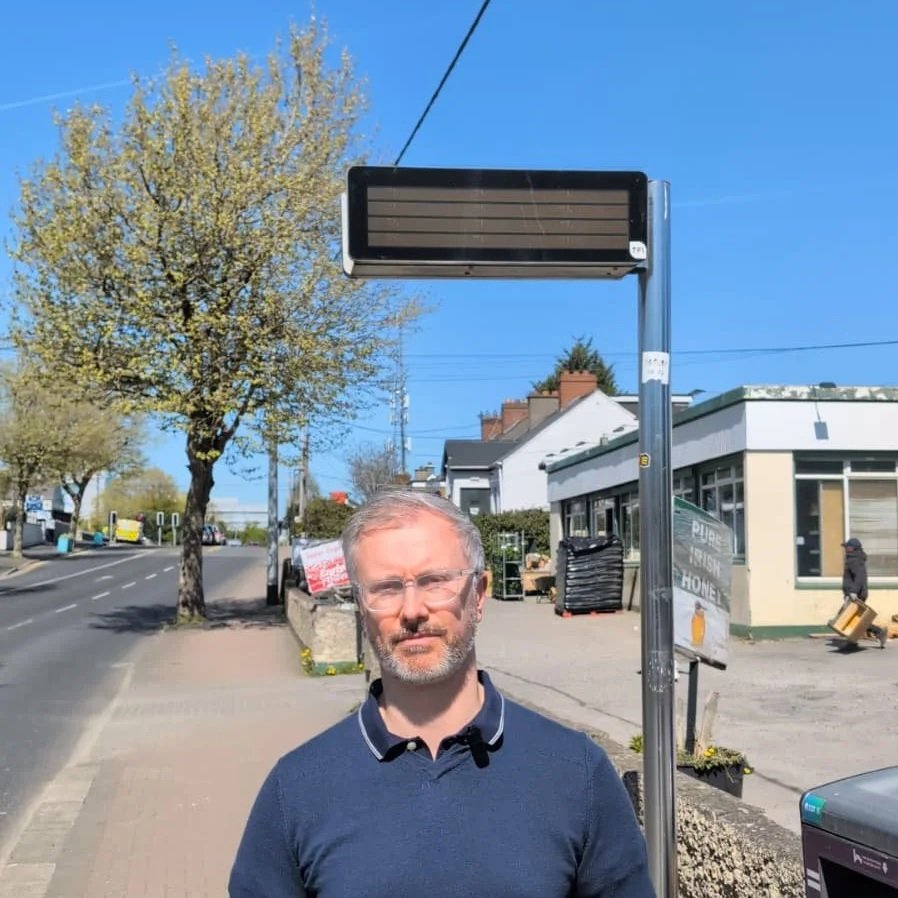
During a recent transport committee meeting with the National Transport Authority(NTA), I raised the issue of the real-time information screen being turned off at bus stops.
There has been a worrying trend of bus stop screens being switched off, depriving commuters of vital information about their journeys. In Blanchardstown village for exampe, where I and hundreds of others rely on these monitors, the two monitors have remained out of service for over three months. When I raised this with the NTA, I learned that the disruption was due to a newly introduced regulation.
These real-time information screens, or bus screens as they are commonly called, are connected to the county council’s public lighting network. In Fingal’s case, this means the screens depend on the local authority’s power supply. The recent decision to switch them off stems from a recently introduced county-level regulation. As a result, the NTA must now apply to the ESB to have these monitors connected to the main electricity grid.
As is often the case with government processes, approvals and action can take considerable time to materialise. What concerns me most is how this decision was made by the county councils and the NTA, with little consultation or forewarning. This rule may soon affect commuters in other counties as well. At a recent committee meeting with the Minister for Transport, I question the approach by both the NTA and Fingal County Council. The Minister agreed the situation is regrettable, particularly the lack of clarity and communication around this new regulation. Without a transparent plan, our public transport infrastructure risks further disruption. The committee agreed to seek further details and push for greater transparency.
In the meantime, commuters are left without essential information that impacts their daily routines. While mobile apps are useful, not everyone has access to a smartphone or the know-how to use such technology. Real-time transport information is not simply a convenience, it is an essential accessibility feature that ensures public transport remains open and inclusive for all.
I do welcome some of the proposals put forward by the NTA to address the electricity issue, including the possibility of connecting the monitors to solar panels or battery systems. Such renewable energy solutions would be a positive step, both for the environment and for keeping costs down. I will continue to pursue this issue to ensure that agencies and government bodies prioritise commuters and that any disruption is kept to a minimum.